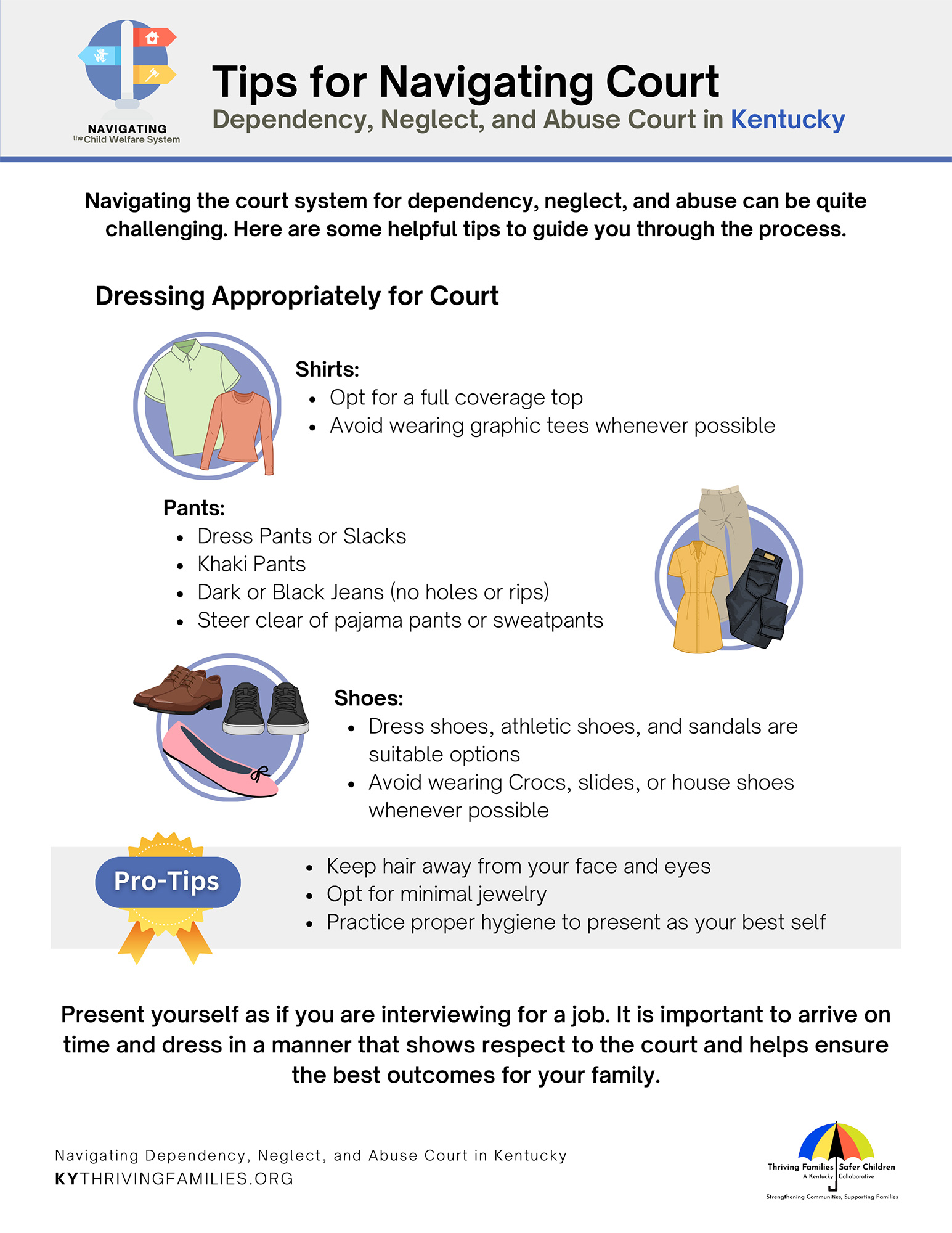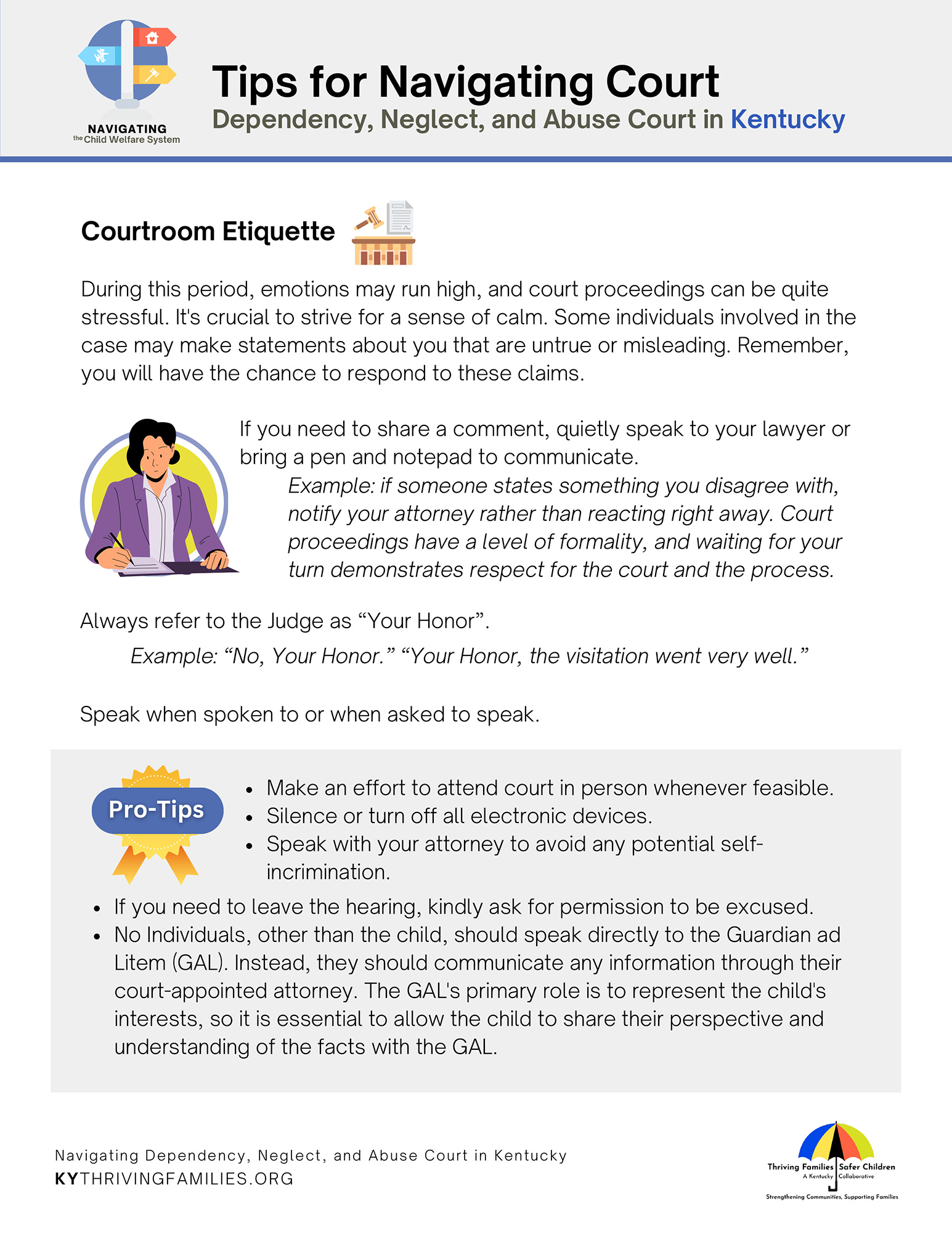

Navigating the court system for dependency, neglect, and abuse can be quite challenging.
Here are tips to help guide families and caregivers through the process.
The Kentucky Courts’ Know Your Rights and Responsibilities Guide Booklet and the Department for Community Based Services Standards of Practice Manual offer additional guidance.
General Resources
How do I access court records?
- Visit the courthouse in the county where the case was processed. Request the records from the Circuit Court clerk, and be sure to bring your state-issued ID along with you.
How to file your own petition
- It is important to note that not everyone can file a petition in every county. It is ideal to contact the circuit court clerk or county attorney in the county you intend to file the petition and ask how this process works.
What can I do if my attorney is not responding to me?
- A person can contact the attorney directly. If possible, call the office and leave a message. If the attorney does not respond, the individual can send an email or a letter detailing their attempts to reach the attorney and include their contact information. Should there still be no reply, the individual can raise this issue at the next court hearing or consider filing a complaint with the State Bar. For more information, visit www.kybar.org.
What if I want a new court appointed attorney?
- You have the option to request a new court-appointed attorney, but be ready to provide reasons for why a change is necessary. Additionally, it’s important to recognize that you can also choose to hire your own attorney.
What if I can’t speak and defend myself?
- Inform your attorney about the key points you believe the court should be aware of. They will determine the most appropriate timing and manner to present this information. If you feel that your representation is inadequate, you have the option to request a new attorney or hire one independently.
Birth Parents
Foster Parents
Youth
Legal Glossary
Other legal or child welfare terminology may arise during the case. It’s crucial for everyone involved to fully comprehend what is being conveyed. If someone encounters a word or acronym they don’t understand, they should reach out to their attorney for clarification.
TPR: Termination of Parental Rights
The Cabinet may file a petition for the termination of parental rights after a significant amount of time has passed and NP’s have not made much progress.
DNA: Dependency, Neglect, and Abuse
-Dependency: This is when a child needs care but the caregiver/parent cannot provide that care through no fault of their own.
-Neglect: Failure of a parent or guardian to provide adequate care and protection of the child.
-Abuse: This is the direct physical or sexual harm to a child.
TRH: Temporary removal hearing
Should the case move forward, it will determine the appropriate placement for the child at this time.
ADJ: Adjudication
Court determines whether the allegations are accurate or not. Testimony has been provided.
Dispo/Disposition
Who should have custody, how the case will proceed. Return the child, give custody to someone else, grant custody to the cabinet.
ICPC: Interstate Compact on the Placement of Children
A contract between two states that allows children to be placed in foster care or adopted across state lines.
CPS: Child Protective Services
Investigates reports of child abuse/neglect and works with families to ensure the child’s wellbeing.
CHFS: Cabinet for Health and Family Services:
An organization that provides services and programs to help keep individuals healthy.
CAC: Children’s Advocacy Center
Provides tools, resources and support for children who have experienced child abuse.
GAL: Guardian Ad Litem
Child’s attorney that was appointed by the court.
CASA: Court Appointed Special Advocate
Trained volunteers who advocate for children in DNA cases. They write reports and update the court on the progress of the case.
Permanency:
Establishing a safe and permanent living situation for a child.
Reunification:
When a child is returned home.
ECO: Emergency custody order
A petition is filed for emergency custody and must be approved by a judge. There must be reason to believe that the child is in immediate harm and needs to be removed as soon as possible.
Fictive kin:
Someone who is not related to the child but has a close relationship with them EX. Neighbors, coaches, teachers, family friends, etc.
NF: Natural Father
Birth Father
NM: Natural Mother
Birth Mother
MGM, MGF: Maternal Grandmother, Maternal Grandfather
Birth Mother’s Mom and Dad
PGM, PGF: Paternal Grandmother, Paternal Grandfather
Birth Father’s Mom and Dad
Tip Sheets